Thursday, April 21, 2011

What I've been doing other than farming:

I've been talking to a woman who grew cotton in the Willamette valley a couple years ago: http://oregoncotton.wordpress.com, and I have also been planing a trip to fiber mills such as Pendleton and Fantasy Fibers near Portland and Creekside Fiber Mill near Corvallis. Also, I've been spinning.

Spinning is the key step to turn a fleece into textile material (unless of course you are a felter, then ignore me). Spinning makes all the rest make so much more sense to me, gives me a greater appreciation of what comes after spinning, and a better understanding of what to do and why before spinning. Buying a ball of red heart yarn from Fred Meyers doesn't make you feel like you know what it takes to get something from the back of a sheep to a hat or sweater or baby blanket. After spinning, I know what to look for when I'm skirting a fleece, and what is “good enough”. Spinning makes me understand the importance of carding and take more time and effort on every step of preparing the fleece. With weaving, dressing the loom takes all the time in the world, and the actual weaving goes fast. Likewise, all the time goes in to preparing the fiber so spinning will be enjoyable.

So to give you all, my readers, people like my mum, a better understanding of everything I've been learning, I'm going to take you from sheep to shawl, as I understand it, focusing on all the different tools as I go through the fiber worlds.

Sheep: Sometimes sheep have blankets to keep them from getting dirty, sometimes it's just careful caretakers who always keep the hay in the feeding troughs and off the heads of the sheep. Sometimes the sheep get a reverse-shop-vac hair blower before they get their new dews. However we can, we try to keep those silly animals as clean as is reasonable.

Sheering: People have all kinds of snazzy equipment for sheering, from swings to lean over, to special lights and clipper stands, sometimes a sheep stand, mats... The important things are really the electric buzzers and a big pair of sheers that look like two big kitchen knives gorilla-taped on to a big metal sprig... pretty scary looking. Once the fleece gets off the sheep, it goes in to labeled plastic bags with firsts, seconds, and thirds (best, okay, really dirty) going in separate bags. Or maybe the thirds can skip the bag and go straight to the garbage or compost.

Skirting: Ideally, the fleeces would immediately be skirted, but some times things are busy, there aren't enough people, and it takes a while to get around to. To skirt, we stretch the fleece across a big mesh skirting table (or a wire pick-nick table or whatever we have). If we're feeling really dedicated, we might even break out the tweezers... lets hope the blankets and blower worked well enough that we don't have to do that too much. If you're showing the fleece, this is as far as you need to go, though you'll be taking a nice long time with those tweezers. If you are felting, you can also probably come up with reasons to stop here.

Washing: Next the less chunky fleece gets divided into mesh, zippered laundry bags (like the kind you might use if you had some fancy langere...) They then get soaked with soap in hot water, some times in a bucket, sometimes a sink, sometimes a specially broken and altered washing machine that promises not to agitate the fleece. Hang or lay flat to dry.

Carding: Once the fiber is good and dry, it's not really fleece any more, it's fiber or wool or whatever else and it's about to become even more things. Also, this is where I started thinking about all the special tools. I call this section carding, but first there is plucking. If you're really lucky, you might even get to use a plucking machine which is a bunch of swinging spikes, more or less, that pulls the fiber apart. Of course, using your hands to pull it apart works just find too. Once the fiber is nice and loose, and even more of the little bits of stuff have fallen out, it can finally get carded into a bat with an electric carder, a hand carder, or a couple of carding paddles (which are pretty much the same thing as a dog brush but really expensive, so if you are like me, dog brushes work just fine). Carding gets all the fiber combed out to be going the same direction and makes a nice little blanket of wool. Oh! Also at this time, the batting could get turned in to roving, which is a long thin bat, and makes spinning that much easier. The big industrial machines do a nice job at this, though by hand, there's not much advantage now rather than right before spinning.

Spinning: So we used the picker and the carder, and now we get to spin the bats or roving into yarn. First we spin single threads either with a spinning wheel, or drop spindle or on your leg, or whatever then take the spools off, and ply (twist) together two or three together into a yarn. If we take two plied yarns and put them together, we can make a cord. Once there is something satisfactory on the spool or bobbin, Then we use a niddy noddy to take the yarn off the bobbin and form it into a skein (big coil or loop). The skein goes on to the umbrella swift, and then can be wound off of that with a little over-priced, plastic ball winder. Now all that fiber is finally ready to be dressed on to a loom, cast on to a pair of knitting needles, or to simply pick up with a crochet hook. 


(I don't have regular internet so posts tend to come in bunches, sorry)

Wednesday, April 20, 2011

Rolly's Fox Hollow

12-3:30pm (3.5hrs)

Fox Hollow Farm is busy getting ready for the big sheering day this weekend. The first order of business was to get the barn cleaned out and ready with its big annual deep cleaning, but to do that, a broken riding mower had to first be pushed out to the drive way, which was definitely a three person job. 


All of the hay that had accumulated during the year from getting bails down or from the dogs digging through bails. We raked and swept and put down boards, then went and let the sheep into the barn in a clever ploy of locking them out so they would think there was something good inside, then letting them in to catch the six that were without coats and redressing them in their newly repaired garments, hoping they will stay on for a few more days until sheering. I love the noise of the sheep running in their coats, and the Romneys seem to run everywhere. 


For the rest of the day, I learned to use the electric carder, which is lots of fun for wool, but just as difficult as the non-electric carder for convincing Suri to go through.


Rolly has found it harder to sell alpaca fleeces than sheep, and the suri's are the hardest to sell, and process, but are beautiful to watch. We blended gray Romney with brightly dyed Suri. 


Monday, April 18, 2011

At McTavish Farm

12:30pm-4pm (3.5hrs)

Because Tracy sheers her own sheep, there are a lot of small sheering days at McTavish Farm. Today, Tracy and I did touch-ups and sheering on a whole line of sheep, some more cooperative than others.


I love the way the fleece peels off the sheep, and suddenly we go from having a big fluffy monster, to a skinny naked sheep and a big thick fleece blanket. It reminds me of taking off armor or peeling a banana. 


Today was a nice hot and sunny day for sheering, which was very welcome. After getting through all the ewes, we spent some quality time in the barn re-socializing one of the ewes and her very shy daughter. The ewes who had triplets were incredibly thin under their fleece, and the ones who only had one baby were a healthy weight or even overly plump. 


Some ewes are just more highly food motivated than others, and when they are, sheering is easier both because they are more egger to jump on the stand for a hand full of grain, and because when they are plump, they are a smoother shape to sheer. 


We also checked the ewes for anemia by looking at the color on the inside of their bottom eye lid and administered worm medicine to the ones that were looking a little pale and anemic. Only giving worming medicine when it looks like it's needed helps prevent drug resistant worms. 


In the middle of our sheering, baby Rikki started to get terribly hungry and made us take a break to give her her eight-hour bottle which she gulped down in record time. She looks twice as big as she was last week, and although she is still shorter than her siblings, she looks fatter than the rest after a nice big bottle. Rikki wasn't very good at keeping the other babies company while there mamas were getting sheered, and preferred to get in to trouble and nibble on plastic.


After all the ladies were nice and cool with their short hair, we spent some time out with the napping babies in the field. Tracy has sixteen babies this year, and has sold six so far. It's hard to give up such cuties.

Sunday, April 17, 2011

Hum Sweet Hum

12-4pm (4hrs)

Today was a day of carding and washing. Suri alpaca fiber is almost impossible to card compared to wool or huacaya alpaca. Cindy had some milk protein fiber to spin and ply with her alpaca.


I've been thinking and thinking, trying to remember the interesting thing I learned and connection to make and I finally have! So, I arrived at Cindy's house while she was on the phone. While waiting for her to finish her call, a man arrived as well. I let him in and we waited. When Cindy was off the phone, we went out to look at Cindy's tree that we had noticed leaning the week before. The man was a tree expert and told us about how horses had scraped away the bark at the bottom of the tree, making it vulnerable, but that was five to ten years ago and alpacas are too small to do that kind of damage (and have soft feet). After sharing a great deal of knowledge on trees with us, he left. We were just settling in to our washing and other tasks when there again was a knock on the door, and I let a second stranger in to Cindy's house. This was a woman, who evidently had talked to Cindy months ago at the alpaca farm visit day. The woman had come to ask when sheering would be. This would be a normal question from someone interested in alpacas, but this woman was different. Evidently, she had come to Cindy's farm early in the morning on farm visit day to ask a million questions about caring for alpacas because she was on her way to pick some up. Cindy advised her at the time not to get those alpacas and wait and learn and get some from the ABC (Alpaca Breeders Connection) group in Lane who could provide her with quality animals and information. The woman didn't listen and went to pick up the animals she had bought. They were semi-wild and neglected, being sold by some pretty sketchy sounding people, and one that she had paid for was not there when she went to pick it up. Again, a pretty sketchy sounding situation. Anyways, the point being, this woman was expecting to put her wild, neglected, dirty, unshorn alpacas in a trailer with halters on and bring them over to Cindy's farm next week to be sheered. To this, Cindy gave a very clear, 'no, that would not be a good idea, and I never agreed to that.' while kindly telling the woman that she would be happy to give her the name of her sheerer who is local and pretty good. The animals will be less stressed out and more manageable that way, and most importantly, not contaminate, disease, or frighten Cindy's very nice and expensive herd.

So, the important thing I learned and correction to make is that Cindy's boarding animals are kept in a separate pen for a few weeks for quarantine to make sure they aren't sick or anything like that, as well as to give them time to adjust and for Cindy to get to know them and them to get to know the other alpacas... from a safe distance. When breeding, an animal from a different farm is brought over, and the pair to mate are kept in a separate pen away from the other animals. ideally, both animals would then be kept in quarantine for three weeks before being returned to their herds. This doesn't always happen, and at least the limited contact of a few minutes to mate is better than the prolonged contact of a new animal coming in to the heard to stay for days. Risks can't always be eliminated, but at least minimizing them by only exchanging animals briefly and only with well-known farms is a good idea.

Sunday, April 10, 2011

McTavish and baby Rikki

9am-1pm (4hrs)

I headed over for a morning on McTavish farm, having talked to Tracy about putting ear tags in the new lambs, pruning lama hooves, cleaning the barn, and a couple more sheep to shear. When I arrived, the sheep and guard lama were out in the field, so doing invasive things to them would have to wait for another day. Instead, we got baby Rikki's bottle ready. The feeding nipple screws on to the end of any regular bottle, which I thought was really cool. Filling Tracy's fridge are tubs and tubs of fresh goat milk from a friend who sells the milk that tastes a little funny and people won't drink to Tracy a little cheaper so she can feed the littlest lamb. Goat milk is pretty close to sheep milk, and seems much better than cow or formula. We microwaved the milk a bit to take the chill off and warm the milk, then headed out to the field, turning off the electric fence as we went by. 


 Down in the field, all the sheep continued grazing or sleeping except one. As soon as baby Rikki saw us coming over the hill, she came running towards us. Having a different person holding the bottle didn't seem to matter as Rikki eagerly gulped down the bottle in under a minute. Rikki's food has  been increasing with her weight for the last couple weeks, but now the food has peaked as she is supposed to be learning to eat grass. Rikki was born almost half the size of her sisters and brothers, but has quickly caught up. When she was first being bottle fed, Tracy was letting Rikki eat until she was full, but little Rikki started to get dangerously overfilled, so her feeding was cut back and regulated. Naturally this happens by the Ewes walking off after letting the lambs feed for a minute. The moms won't stand still, so the babies get fed a little bit at a time. For Rikki, feeding has been cut back to every four hours during the day and eight at night (no two-am feeding for this lamb), as well as plateauing in amount. The other babies should also be learning to eat grass now, and the ewes milk production has hit its peak.

(Baby Rikki drinking her Mountain Dew goat milk)


After feeding Rikki, we sat down in the grass to babysit as all the other lambs came running for attention. As the girls climbed over us and cuddled, we had to keep the little boys off and only pet them under their chin with their heads up to try to discourage them from attacking humans when they get older. All the baby lambs have now been sold, except for a few like Rikki who are on the farm to stay.


This little girl below was being very shy when a woman came to look at her, but it seems to have been a momentary problem as she was happy to cuddle today. Spending time with the lambs so that they are well socialized and comfortable with humans from a young age is one of the bigger selling points for these little guys.


After the fun of playing with the babies was over, a neighborhood high school boy came over to do some work, so we eagerly handed over the barn to be cleaned and instead took out a very large mesh table to skirt show fleeces. Evidently the cleanliness of the fleece is one of the biggest things a judge will look for and can make the difference between a blue ribbon and last place. Credit for clean fleeces is either given to the woman who tediously sits for hours with tweezers, going over every inch of the fleece, or to the well trained husband who listens to his wife and is careful to get all the hay in the feeder and none of it on the sheep's heads when he is taking a turn at that chore. (No spinning, skirting woman would ever get hay on the back of a sheep.) The first fleece was very fine and had lots of vegetable matter in it. We removed the worst parts, and spent some time with the tweezers before giving up and rolling up the fleece. The rest of the fleeces to be shown were much better and hardly required any picking and cleaning at all. The large mesh of the table and light breeze helped to get the vegetable matter off. Though Shetland sheep are very small, their fleeces are huge from being so dense and fine. this table is probably four feet by eight feet. Before skirting fleeces, we had taken an already skirted fleece that is not going to be shown, divided it into mesh laundry bags, and put them in water to soak. According to Judith, Goddess-queen of all things spinning, the best way to wash your fleece is to start with a cold soak in a bucked of water that is saved and reused over and over again. The bucket is like a composting sludge, breeding microorganisms that eat things like lanolin and clean the fleece. This is the "like cleans like" theory. I can't say I'd want to clean anything else in that water, but it seemed to be working for Tracy's fleeces.


Before leaving for the day, we took a tour of the spinning wheel workshop to see the progress. The wheels are beautiful and in their final steps to completion. Tracy's husband, Tom, is currently building three wheels. He is taking one up to his mentor every week to learn the next steps, then comes home and practices it over and over again on the next two wheels. The three wheels are each at different stages of completion, and as soon as the first is finished, Tom will begin a third to keep the steps fresh in his mind until he is sure he has learned all the steps and skills.

Friday, April 8, 2011

Back at Hum

10:30am-4:30pm (6hrs)

As I arrived on Cindy's farm, so did the first load of the eight new alpacas coming to board at Hum Sweet Hum for the month. Boarding and breeding seem to be the two main incomes for alpaca farmers. Though the fiber is nice, it takes a lot of work to process and sell. In the background of this picture you can see Cindy's Element. The boarders were taking bringing four alpacas at a time in their sweet trailer, but when Cindy's alpacas hit the road, between two and four will pile in to the back of that little red car. Alpacas prefer not to pee and poop in confined spaces, so usually will hold it - even for longer rides, and generally will stay laying down or "cush" for the ride. The trick is getting the second, third, and fourth alpaca in without the first ones getting out. With this trailer, the animals were haltered and put on leads, then tied to places inside the trailer. 


Some of the young alpacas had never ridden in a trailer and were a little shaky coming out, but once freed, they joyfully bolted all around their new pasture, meeting the neighbors cows and racing their new friends. When the boarders first come, Cindy tends to keep them in a separate pasture from her animals until they settle in. A pair of long term boarders came a couple weeks ago and were booted out of the guest pasture and in to the main one when these guys arrived. 


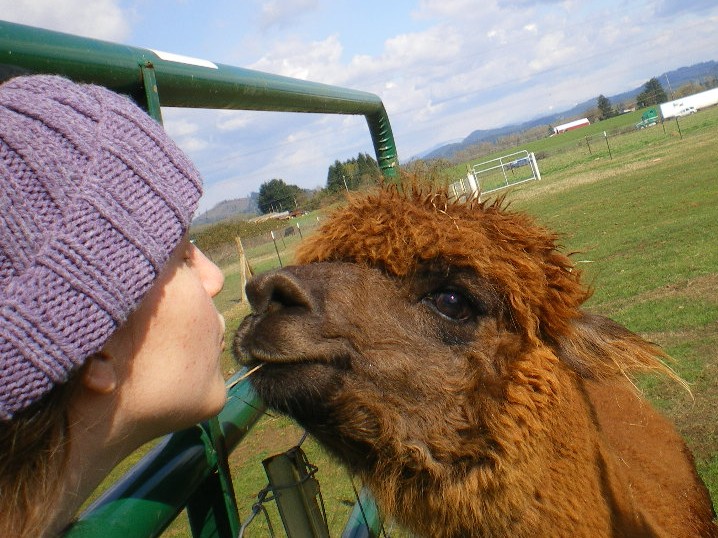
The previous two had come down from Idaho and were quite shy when they first arrived, but are now getting more comfortable - not so with these eight who were kissing strangers right off the bat. Alpacas have sweet breath from the way they process food and think we smell pretty funny. (They have modified ruminant digestion. they chew their cud, though they are not quite like cows, and when that green stuff comes up, you probably want to hold off the the kisses.)


Back inside, I set to work carting wool into bats. On my first (working) visit to Hum Sweet Hum, skirted and washed fleeces. The next step from alpaca to finished product is the carting. I took the slightly felted wool, and pulled it apart by hand into a big fluffy pile of fiber, still more or less going the same way. Then I took small sections and fed them into the left side of the carting machine where the licker (that smaller toothed roller) picked it up and brought it to the main carting drum (the large one on the right). Once there is a thick layer around the drum, I took a tool, like a long nail with a handle, and separated the fibers along a line across the drum and peeled the sheet of fiber off. Sometimes the fiber needs to go through more than once, depending the animal it came from, how nice it needs to be, etc. I decided once was enough for today. Each sheet gets twisted and wrapped into a nice neat bundle, as seen, thrown in a bin with others of it's kind, then the next one get made. We start with the lightest fleece, do all of that fleece, then move gradually darker. If we felt so inclined, we could also mix fibers at this stage, like silk and merino.


An irrelevant side note on silk: the kind of silk we generally use comes from a domesticated insect - yes, that's right, a domesticated insect - that cannot survive without humans. The moths, if they are to hatch, are blind and flightless, even though they have big white wings. They are pretty cool looking but kind of sad. There are also some kinds of silk worms that have been developed to spin their silk cocoon so strong that it is impossible for them to break through once they become moths and they die trapped in the little coffin they made around themselves. I now have mixed feelings about silk, though it is an amazing fiber...

For my lunch break, I sat down to flip through some fiber magazines while I waited for the quesadillas to  cook. And what a fine looking gentleman they have on the cover of this one. I found this funny.


 After lunch it was time for some physical labor. Cindy and I got to work cleaning out and organizing the shed to be ready for sheering in two weeks. We removed garbage, empty boxes, and bad fiber (I took many garbage bags full of seconds and a couple large bags of stinky thirds got thrown away). Then we sorted to put tools, feed, and things on one half of the shed and the other half for alpaca things, including a shelf for shows and a shelf for sheering and sorting out the old fiber between seconds, firsts, and by color from light to dark. Meanwhile, Cindy's handyman came by and was doing some alpaca shelter roof repairs and building new hay troughs.


The day ended with some afternoon chores - distributing fresh hay and water. All the alpacas were eager to line up to have their toes hosed, and some time with the hose was a nice welcome present to the newest boarders.


One of the alpacas had been limping and favoring one leg all day. Cindy ran her hands over the alpaca and found some tenderness but nothing obvious. we kept her in a separate pen all day with her mom and favorite friend and Cindy waited to hear back from some doctor-friends with advice. The alpaca seemed to appreciate having the injured ankle iced with cold water at the end of our sunny day. 

Wednesday, April 6, 2011

The Cold Reality of Sheep Farming

11:30-3:45 (4:15)

My second trip to Rolly's farm started a little later in the day, when the farm was in full swing, bustling away. Due to the foster puppy inhabiting what is normally Rolly's workshop kitchen, we were banished to dying on the porch, which should be wonderful in April in Eugene, but not today. It was snowing and we were untying tiny knots around skeins of yarn that had been soaking in cold water for the last couple days. I took a picture of the snow on my jacket but it seems my camera didn't think that image needed to be saved (the camera was full of pictures so you only get one for now). In short, it was FREEZING! I think all my fingers and toes went numb.


Anyways, the flow for the day was to squeeze the water out of the skeins we had put in to soak before, and untie and retie the little pieces of string around them to make it loose enough that the dye can properly permeate the yarn. Again working with five skeins at a time, we set up crock pots and electric canning pots all around the house, set the temperature to simmer around 180F I believe, added some vinegar (scientific method: a few glugs), some dye, and then the yarn. While those pots sat to simmer until the water turns clear and the yarn has absorbed all the dye, we headed out to the fields. 

All of the animals: dog, sheep, and alpaca, needed to be let out to pasture which took some juggling. The two female dogs could not share a fence line, some fields are accessed by going through other fields, and the alpacas and sheep needed to be separated. I learned the key difference between alpacas and sheep today on Rolly's farm: sheep run everywhere. Alpacas meander. Rolly opened the gate, and out came an egger stampede of sheep, all thinking, "there might be food! there might be food!" A few minutes later, the alpacas on the far side of the field look up. Rolly shouts back at them not to bother heading this way, and we walk around to let them through a maze of dog-proof fencing to their own field. The rams also have their own pen, and have taken to humping each other - it seems one of the females is in heat and these poor boys can't help themselves. 

Three years ago, Rolly retired from the breeding business. One of her rams wasn't listening very well and had his own plans. Last year or the year before, he got out and got friendly with a bunch of the ewes; including his mother. Now there is a pair of inbred sister and brother wandering about with a few brain cells missing and some unique fleece. 

With all the animals put out to graze and the thunder and lightning and rain/snow/sleet/snane/hail coming down harder than ever, we set to shoveling out the barns - in record time. After all that, it was time to warm up for a while until the sheep were ready to come back in - about an hour. We headed upstairs to the spinning studio and set up some equipment in front of the heater to salvage some very magenta yarn that had been sitting for too long and had gotten eaten by the moths and the puppy and now were tangled messes of broken ends instead of skeins. Theoretically, we would open the skein onto the umbrella swift, and connect the end to the electric skein winder, and we would have a nice, newly wound skein. In reality, we spend the hour picking out ends and untangling the yarn bit by bit to get it on the skein winder. At least it was nice and warm. 

When we felt a satisfactory level of frustration and had enough small victories of making miniature balls of hot pink yarn from the broken pieces, we headed back out to undo the shuffle of the animals (too much grass and they get the runs...). We nicely prepped all the barns with hay and oats to encourage the animals back in, though the icy rain probably helped too, and then began opening gaits. The first in was a little old alpaca who got her own special pen in the corner farthest from the opening and with her own private line of dining options. She happily led herself right in, though she gave me the wide berth a stranger deserves. Next were her grazing companions - a couple other alpacas and a sick ram in need of a shot. After a couple attempts to catch him for the shot which he was carefully evading, we opened the sheep gate. Sure enough, the stampede came thundering back in at a full run with the same "food, food, food" look in their eyes. The rams and single unaltered male alpaca across the way required some shaking of the food bucket for them to be reassured enough to come charging in for supper. By this time, the sick ram had probably let his guard down about us trying to catch him for a shot, and we had a new sneak attack planned, so in we went again and finally caught the ram. Rolly handed me the ram's head with the instructions to "hold him like this" with his chin straight up in the air. It seemed to work, the large snouted creature held still as Rolly undressed one leg and stuck him with a shot in his hind. 

Most of the dyes had exhausted (meaning the water was clear and the yarn colored), so we unplugged them and let them sit to cool off. Our final task was to put some roving in to dye. Roving is the wool after it has been washed and carted (brushed) and pulled in to a long, thick, fuzzy ropes, ready for spinning. Again, we started with the crock pot and some water, added vinegar when it was hot, and then I picked red dye to go in the bottom of the pot. Half the roving went in to the pot, then I picked red, orange, and yellow to go on next. We folded the rest of the roving over that into the water, and put the same colors in the same order on top. We gently patted the fiber into the dye to make sure everything was getting colored, then left it to sit for a while.